

What Is Colombia Named After
| República de Colombia Republic of Republic of colombia | ||||||
|---|---|---|---|---|---|---|
| ||||||
| Motto: "Libertad y Orden" (Castilian) "Liberty and Guild" | ||||||
| Anthem: ¡Oh, Gloria Inmarcesible! (Castilian) O unfading celebrity! | ||||||
| | ||||||
| Capital (and largest city) | Bogotá 4°39′Northward 74°3′Westward | |||||
| Official languages | Spanish ane | |||||
| Recognized regional languages | The 72 languages and dialects of indigenous groups are also official in their regions.[1] | |||||
| Indigenous groups | 87.6% White or Mestizo six.8% Afro-Colombians (includes Mulatto, Raizal, and Palenquero) 4.three% Amerindian ane.4% Unspecified[2] | |||||
| Demonym | Colombian | |||||
| Authorities | Unitary presidential democracy | |||||
| - | President | Gustavo Petro | ||||
| - | Vice President | Francia Márquez | ||||
| Independence | from Spain | |||||
| - | Declared | July 20, 1810 | ||||
| - | Recognized | August 7, 1819 | ||||
| - | Current constitution | 1991 | ||||
| Area | ||||||
| - | Total | 1,141,748 km² (26th) 440,831 sq mi | ||||
| - | H2o (%) | eight.8 (17th) | ||||
| Population | ||||||
| - | 2021 estimate | fifty,355,650[ii] (29th) | ||||
| - | Density | 42.23/km² (173rd) 105.72/sq mi | ||||
| Gross domestic product (PPP) | 2022 gauge | |||||
| - | Full |  $940.589 billion[3] (32nd) $940.589 billion[3] (32nd) | ||||
| - | Per capita | $xviii,225[3] (84th) | ||||
| GDP (nominal) | 2022 judge | |||||
| - | Full | $351.281 billion[3] (43rd) | ||||
| - | Per capita | $6,806[3] (97th) | ||||
| Gini (2020) | 54.ii[4] | |||||
| Currency | Peso (COP) | |||||
| Time zone | (UTC-5 2 ) | |||||
| Internet TLD | .co | |||||
| Calling lawmaking | [[++57]] | |||||
| i | Although the Colombian Constitution specifies Spanish as the official linguistic communication in all its territory, the native languages (approximately 88 dialects) are too official in the whole country. | |||||
| 2 | The official Colombian time, is controlled and coordinated by the state agency Superintendency of Manufacture and Commerce.[five] | |||||
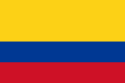

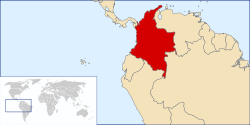
Colombia, officially the Colombia, is a land located in the northwestern region of South America. It is bordered to the due east by Venezuela and Brazil, to the southward by Republic of ecuador and Peru, to the northward by the Atlantic Ocean (through the Caribbean Bounding main), and to the w by Panama and the Pacific Ocean. It is the only Southward American state with both Atlantic and Pacific coasts.
Colombia is the 26th largest nation in the world and the fourth-largest land in Due south America (later Brazil, Argentina, and Peru), with an area more than than twice that of France.
The state suffers from low-intensity conflicts involving rebel guerrilla groups, paramilitary militias, drug traffickers, and corruption. The disharmonize originated around 1964-1966, when the Revolutionary Military of Colombia (FARC) and the National Liberation Ground forces (ELN) were founded and began their guerrilla insurgency campaigns against successive Colombian regime administrations.
The word "Colombia" comes from the proper name of Christopher Columbus (Cristóbal Colón in Spanish, Cristoforo Colombo in Italian). Originally a reference to the New World, particularly to all American territories and colonies under Spanish and Portuguese rule, the name was adopted past the Democracy of Colombia of 1819 formed by the union of Venezuela, New Granada, and Ecuador.
Contents
- 1 Geography
- ane.1 Climate
- 1.2 Vegetation
- 2 History
- 2.1 Pre-Columbian era
- two.2 Colonial era
- 2.3 Independence from Spain
- 2.iv Political struggle
- two.5 La Violencia
- two.half dozen The National Front end
- 2.seven Colombian armed conflict
- 3 Regime
- 3.1 Administrative divisions
- 4 Economic system
- 4.1 Tourism
- 5 Demographics
- 5.1 Indigenous peoples
- five.ii Immigrant groups
- 5.3 Indigenous groups
- v.4 Religion
- 5.v Offense
- 5.6 Human being rights situation
- 6 Civilisation
- 6.1 Education
- 7 Transportation
- 8 Notes
- 9 References
- x External links
- 11 Credits
In 1830, when Venezuela and Republic of ecuador separated, the region that remained became a new land: The Republic of New Granada. In 1863 New Granada changed its proper name to United states of Republic of colombia, and in 1886 adopted its present name: Republic of Republic of colombia.
Geography
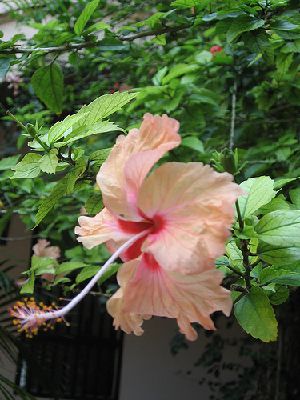
Beauty in a Colombian bloom.
Colombia has more physical variety packed into its borders than whatsoever other surface area of comparable size in Latin America. The country is part of the Pacific Ring of Fire, a region of the globe characterized past frequent earthquakes and volcanic eruptions.
Colombian surface features form complicated patterns. The western third of the country is the virtually complex. Starting at the shore of the Pacific Ocean in the due west and moving east, a various sequence of features is encountered. In the farthermost west are the very narrow and discontinuous Pacific coastal lowlands, which are backed by the Serranía de Baudó, the lowest and narrowest of Colombia'due south mount ranges. Next is the broad region of the Río Atrato/Río San Juan lowland, which has been proposed equally a possible alternate to the Panama Canal as a man-fabricated route betwixt the Atlantic and Pacific Oceans.
The chief western mountain range, the Cordillera Occidental, is a moderately high range with peaks reaching upwardly to about 13,000 ft (4,000 one thousand). The Cauca River Valley, an important agricultural region with several large cities on its borders, separates the Cordillera Occidental from the massive Cordillera Central. Several snowfall-clad volcanoes in the Cordillera Central have summits that rising higher up xviii,000 ft (five,500 m). The valley of the slow-flowing and dirty Magdalena River, a major transportation avenue, separates the Cordillera Fundamental from the main eastern range, the Cordillera Oriental. The peaks of the Cordillera Oriental are moderately loftier. This range differs from Colombia'south other mountain ranges in that it contains several large basins. In the eastward, the sparsely populated, apartment to gently rolling eastern lowlands chosen llanos embrace near 60 percent of the country'south full land area.
This cross department of the republic does not include two of Colombia's regions: the Caribbean littoral lowlands and the Sierra Nevada de Santa Marta, both in the northern part of the country. The lowlands in the west are mostly swampy; the reed-filled marshes of the area are called ciénagas. The Guajira Peninsula in the east is semiarid. The Sierra Nevada is a spectacular triangular snowcapped block of rock that towers over the eastern function of this lowland.
Climate
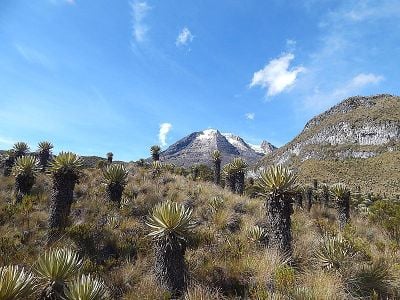
Mountain climate is one of the unique features of the Andes and other high altitude reliefs
Colombia'southward proximity to the equator influences its climates. The lowland areas are continuously hot, simply altitude greatly affects temperature. Mountain climate is one of the unique features of the Andes and other high altitude reliefs where climate is adamant by meridian. Beneath 1,000 meters (iii,281 ft) in pinnacle is the warm altitudinal zone, where temperatures are in a higher place 24 °C (75.2 °F). About 82.v percent of the land'south total area lies in the warm altitudinal zone. The temperate climate altitudinal zone located between 1,001 and 2,000 meters (iii,284 and 6,562 ft) is characterized for presenting an boilerplate temperature ranging between 17 and 24 °C (62.6 and 75.2 °F). The cold climate is nowadays betwixt ii,001 and 3,000 meters (half-dozen,565 and ix,843 ft) and the temperatures vary between 12 and 17 °C (53.6 and 62.six °F). Beyond lies the alpine weather condition of the forested zone and so the treeless grasslands of the páramos. To a higher place 4,000 meters (13,123 ft), where temperatures are below freezing, the climate is glacial, a zone of permanent snow and ice.
Rainfall varies by location in Colombia, disposed to increase every bit one travels due south. This is peculiarly truthful in the eastern lowlands. For example, rainfall in parts of the Guajira Peninsula seldom exceeds 30 in (75 cm) per twelvemonth. Colombia'southward rainy southeast, all the same, is ofttimes drenched by more than 200 in (500 cm) of rain per yr. Rainfall in about of the rest of the state lies between these two extremes.
Vegetation
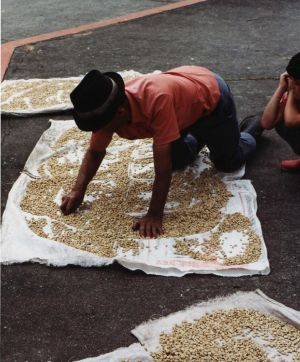
A coffee farmer meticulously sorts coffee beans near Armenia, Quindío.
Altitude affects not but temperature merely besides vegetation. In fact, altitude is one of the nearly important influences on vegetation patterns in Colombia. The mountainous parts of the country tin can be divided into several vegetation zones according to distance, although the altitude limits of each zone may vary somewhat depending on the breadth.
The "tierra caliente" (hot land), below 3,300 ft (1,000 1000), is the zone of tropical crops such every bit bananas. The tierra templada (temperate country), extending from an altitude of 3,300 to 6,600 ft (one,000 to 2,000 m), is the zone of coffee and maize.
Wheat and potatoes boss in the "tierra fría" (cold land), at altitudes from 6,600 to 10,500 ft (2,000 to 3,200 m). In the "zona forestada" (forested zone), which is located between 10,500 and 12,800 ft (3,200 and 3,900 m), many of the trees take been cut for firewood. Treeless pastures dominate the páramos, or alpine grasslands, at altitudes of 12,800 to xv,100 ft (3,900 to 4,600 g). In a higher place 15,100 ft (iv,600 thousand), where temperatures are beneath freezing, is the "tierra helada," a zone of permanent snow and ice.
Vegetation also responds to rainfall patterns. A scrub woodland of scattered trees and bushes dominates the semiarid northeast. To the due south, savanna (tropical grassland) vegetation covers the Colombian portion of the llanos. The rainy areas in the southeast are blanketed by tropical rainforest. In the mountains, the spotty patterns of precipitation in alpine areas complicate vegetation patterns. The rainy side of a mountain may exist lush and light-green, while the other side, in the rain shadow, may be parched.
History
Pre-Columbian era
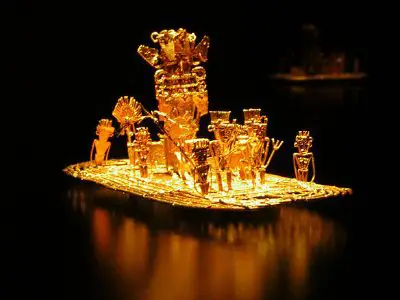
The Zipa used to cover his body in gold and, from his raft, offered treasures to the Guatavita goddess in the heart of the sacred lake. This Muisca tradition became the origin of the El Dorado legend.
The commencement humans are believed to accept arrived in the area from Central America about 20,000 B.C.E. Circa 10,000 B.C.E., hunter-gatherer societies existed virtually present-twenty-four hour period Bogotá that traded with 1 some other and with cultures living in the Magdalena River Valley.[6] Further waves of Mesoamericans—indigenous peoples of Central America—arrived between 1,200 and 500 B.C.E. and introduced maize. The Chibcha people came from nowadays-24-hour interval Nicaragua and Honduras betwixt 400 and 300 B.C.E. They grew potatoes, corn, and other crops; developed irrigation systems; mined emeralds and salt; and built roads and pause bridges.
Within Colombia, the two cultures with the most complex ability structures were the Tayronas on the Caribbean area declension and the Muiscas in the highlands around Bogotá, both of which were of the Chibcha linguistic communication family. The Muisca people are considered to accept had one of the most developed political systems in South America, after the Incas.[7]
Colonial era
Spanish explorers made the first exploration of the Caribbean littoral in 1500 led by Rodrigo de Bastidas. Christopher Columbus navigated about the Caribbean area in 1502. In 1508, Vasco Nuñez de Balboa began the conquest of the territory through the region of Urabá. In 1513, he was also the first European to discover the Pacific Body of water, which he called Mar del Sur (or "Sea of the South") and which in fact would bring the Spaniards to Peru and Republic of chile.
In 1510, the first European urban center in the Americas was founded, Santa María la Antigua del Darién. The territory's master population was made upwards of hundreds of tribes of the Chibchan and "Carib," currently known equally the Caribbean people, whom the Spaniards conquered through warfare. Resulting disease, exploitation, and the conquest itself caused a tremendous demographic reduction among the indigenous peoples. In the sixteenth century, Europeans began to bring slaves from Africa.
Independence from Kingdom of spain
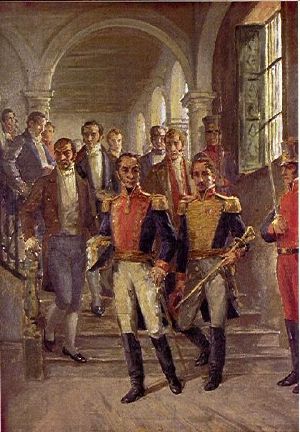
Since the beginning of the periods of conquest and colonization, there were several insubordinate movements nether Castilian rule, virtually of them either being crushed or remaining as well weak to alter the overall situation. The last one, which sought outright independence from Spain, sprang up around 1810, following the independence of St. Domingue in 1804 (nowadays-day Haiti), which provided a degree of support to the eventual leaders of this rebellion: Simón Bolívar and Francisco de Paula Santander, who became the first two presidents of Colombia. The rebellion finally succeeded in 1819, when the territory of the Viceroyalty of New Granada became the Commonwealth of Greater Colombia, organized as a confederation forth with Ecuador and Venezuela (Panama was part of Colombia).
Political struggle
Internal political and territorial divisions led to the secession of Venezuela and Quito (today's Republic of ecuador) in 1830. At this fourth dimension, the name New Granada was adopted, which it kept until 1856 when it became the Grenadine Confederation. Afterward a two-twelvemonth civil war, in 1863, the United States of Republic of colombia was created, lasting until 1886, when the country finally became known as the Republic of Colombia.
Internal divisions remained, occasionally igniting encarmine civil wars, the near meaning beingness the Thousand Days civil war (1899-1902). U.S. intentions to build the Panama Canal led to the separation of Panama in 1903 and its establishment as a split nation. Colombia was as well engulfed in a year-long war with Peru over a territorial dispute involving the Amazonas Department and its capital Leticia.
La Violencia
Presently afterward Republic of colombia achieved a relative degree of political stability, which was interrupted by a bloody conflict that took place between the late 1940s and the early 1950s, a period known equally La Violencia ("The Violence"). Its cause was mounting tensions between the ii leading political parties, which ignited subsequently the bump-off of the Liberal presidential candidate on Apr 9, 1948. This assassination caused riots in Bogotá. The violence spread throughout the country and claimed the lives of at to the lowest degree 180,000 Colombians. From 1953 to 1964 the violence betwixt the two political parties decreased, get-go when Gustavo Rojas deposed the president in a insurrection d'etat and negotiated with the guerrillas, then under the military junta of General Gabriel París Gordillo.
The National Front
The 2 main political parties—the Conservative Political party and Liberal Party—agreed to create a coalition government. The presidency would alternate between parties every four years; the parties would accept parity in all other constituent offices. The National Front ended "La Violencia" and attempted to institute far-reaching social and economic reforms in cooperation with the Brotherhood for Progress. In the finish, the contradictions between each successive Liberal and Conservative administration fabricated the results decidedly mixed. Despite progress in certain sectors, many social and political injustices continued. Guerrilla movements including FARC, ELN, and M-19 were created to fight the government and political appliance.
Colombian armed conflict
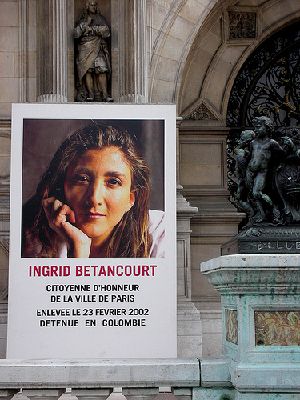
Poster of Ingrid Beancourt in Paris, French republic, on the fifth ceremony (February 2007) of her kidnapping by FARC.
During the belatedly 1970s and throughout the 1980s and 1990s, powerful and violent drug cartels emerged, mainly the Medellín Cartel (under the command of Pablo Escobar) and the Cali Cartel, which exerted political, economic, and social influence in Republic of colombia during this period. These cartels also financed and influenced different illegally armed groups across the political spectrum.
To replace the previous 1886 constitution, a new constitution was ratified in 1991 that included cardinal provisions on political, indigenous, human, and gender rights, which accept been gradually put in practise, though uneven developments, surrounding controversies, and setbacks have persisted. The new constitution too initially prohibited the extradition of Colombian nationals to the Us. The drug cartels were accused of lobbying in favor of this prohibition and carried out a violent entrada against extradition that included terrorist attacks and mafia-style executions. Drug cartels attempted to influence the government and the political structure of Colombia past means of corruption.
In recent decades, the country has continued to be plagued past the effects of the influential drug trade, guerrilla insurgencies like FARC, and paramilitary groups such as the AUC (later demobilized, though paramilitarism remains agile), which, along with other minor factions, have engaged in a encarmine internal armed conflict.
Analysts claimed that the drug cartels helped the Colombian merchandise balance through a steady and substantial influx of foreign currency, mainly U.S. dollars, though other negative economical and social furnishings also resulted. The drug lords have also destabilized the regime.
The different irregular groups ofttimes resort to kidnapping and drug smuggling to fund their causes. They tend to operate in the remote rural countryside and can sometimes disrupt communications and travel between regions. Colombia's most famous hostage, especially internationally, was Ingrid Betancourt, a former senator and presidential candidate known as an outspoken and daring anti-corruption activist. She was kidnapped past FARC in 2002, while campaigning for the presidency and was finally rescued by the government in 2008.
Since the early 1980s, attempts at reaching a negotiated settlement betwixt the government and different rebel groups have been made, either declining or achieving only the partial demobilization of some of the parties involved. One of the latest such attempts was made during the administration of President Andrés Pastrana, which negotiated with the FARC between 1998 and 2002.
In the late 1990s, President Andrés Pastrana implemented an initiative named Programme Colombia, with the dual goal of ending the armed conflict and promoting a strong anti-narcotic strategy. The almost controversial chemical element of the Plan, which as implemented also included a smaller number of funds for institutional and culling development, was considered to be its anti-narcotic strategy, consisting of an increase in aerial fumigations to eradicate coca. This activity came under fire from several sectors, which claimed that fumigation as well damaged legal crops and has adverse wellness effects for populations exposed to the herbicides. Critics of the initiative also merits that the plan represents a military approach to problems that take their roots in the social inequalities of the country, and that information technology causes coca farmers to clear new fields for crops deeper inside jungle areas, significantly increasing the rate of deforestation.
During the presidency of Álvaro Uribe, who was elected on the promise of applying military machine force per unit area on the FARC and other criminal groups, some security indicators have improved, such equally a decrease in reported kidnappings (from three,700 in 2000 to 800 in 2005) and a subtract of more than than 48 percent in homicides between July 2002 and May 2005. It is argued that these improvements take favored economic growth and tourism.
Uribe, who took function in August 2002, is a staunch U.S. ally whose country was the but ane in South America to join the U.S.-led coalition in Republic of iraq. He met President George Bush-league several times, most recently in May 2007.
Government
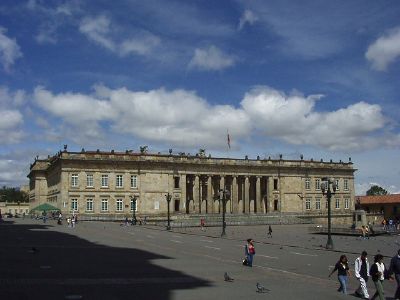
The National Capitol Edifice houses the Colombian Congress. Downtown Bogotá.
- Executive co-operative
- Republic of colombia is a republic where the executive branch dominates the government construction. Until recently, the president was elected together with the vice president by popular vote for a single four-year term; he functioned equally both caput of regime and head of country. However, on October xix, 2005, the Colombian Congress amended the constitution, which now allows Colombian presidents to serve two sequent four-twelvemonth terms. However, department governors, mayors of cities and towns, and other executive branch officials are only elected for a three-twelvemonth term and cannot be immediately re-elected.
- Legislative branch
- Colombia'south bicameral parliament consists of a 166-seat Chamber of Representatives and an 102-seat Senate. Members of both houses are elected by popular vote to serve four-yr terms. Colombia too elects department deputies and city quango members.
- Judicial branch
- In the 1990s, the Colombian judicial system underwent significant reforms and switched from an inquisitorial to an adversarial system. The judicial organization is headed past the Constitutional Court and members are appointed by Congress out of nominations made by the president and other high-ranking tribunals.
Administrative divisions
Colombia is divided into 32 departments and one capital district. The departments are subdivided into one,119 municipalities and have ten districts, the Old Four (Bogota, Barranquilla, Cartagena, and Santa Marta) and the New Six (Tunja, Cucuta, Popayan, Buenaventura, Tumaco, and Turbo).
Economy
Subsequently experiencing decades of steady growth (boilerplate Gross domestic product growth exceeded iv percent in the 1970-1998 menstruation), Republic of colombia experienced a recession in 1999 (the offset full yr of negative growth since 1929), and the recovery from that recession was long and painful. Colombia's economy suffers from weak domestic and strange demand, austere regime budgets, and serious internal armed conflicts.
Colombia's chief exports include manufactured appurtenances, petroleum, coal , and coffee.
Colombia is also the largest exporter of plantains to the United States. Within Latin America, Colombia is known as a provider of fine lingerie, with the industry beingness centered in Medellín. All imports, exports, and the general merchandise balance are in record levels, and the inflow of consign dollars has resulted in substantial revaluation of the Colombian peso.
The bug facing the land range from pension system issues to drug dealing to moderately high unemployment (12 pct). Several international financial institutions have praised the economic reforms introduced by current
Tourism
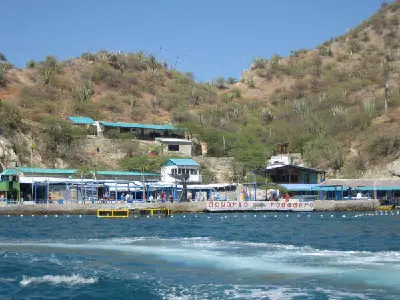
Rodadero Aquarium virtually Santa Marta.
Most tourists come to Colombia during the famous festivals, such as the Cali Fair, the Barranquilla Funfair, the Bogotá summer festival, the Iberoamerican Theater Festival, and the Blossom Festival. Many people visit Colombia during the Christmas season and the celebrations surrounding independence day.
Even though Colombia has been plagued with travel advisories because of the activities of FARC and other guerrilla groups, it has continued to attract more tourists.
Demographics
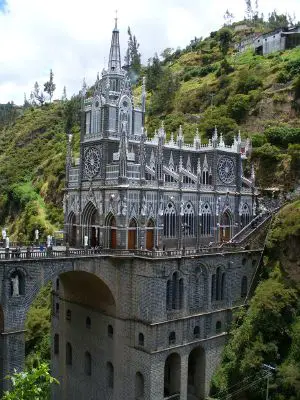
Las Lajas Cathedral in Nariño.
Motion from rural to urban areas was very heavy in the mid-twentieth century but has since tapered off. The urban population increased from 31 percent of the total population in 1938 to 57 percent in 1951 and seventy percent by 1990. The nine eastern lowlands departments, constituting about 54 per centum of Colombia's area, have less than 3 pct of the population and a density of less than 2 persons per square mile (1 person per sq km).
The state has a various population that reflects its colorful history and the peoples that take lived there from ancient times to the present. The historic constructing of the different primary groups forms the nuts of Republic of colombia's current demographics: European immigrants, indigenous natives, Africans, Asians, Eye Easterners, and other recent immigrants. Many of the indigenous peoples were captivated into the mestizo population, merely the remaining 700,000 currently represent over 85 singled-out cultures.
The European immigrants were primarily Spanish colonists, but a pocket-sized number of other Europeans (Dutch, German, French, Swiss, Belgian, and in smaller numbers, Smoothen, Lithuanian, English, and Croatian communities) immigrated during Earth War Ii and the Cold State of war. For case, former Bogotá mayor Antanas Mockus is the son of Lithuanian immigrants.
Africans were brought as slaves, by and large to the littoral lowlands, offset early in the sixteenth century and standing into the nineteenth century. After abolition, a national ideology of mestizaje encouraged the mixing of the indigenous, European, and Native Amerindian communities into a single mestizo ethnic identity.[8] Other immigrant populations include Asians and Middle Easterners, particularly Lebanese, Jordanians, Syrians, Chinese, Japanese, and Koreans.
Indigenous peoples
Before Spanish colonization of the region that would go Colombia, the territory was home to many different indigenous peoples. Today more than than 50 dissimilar indigenous indigenous groups exist in Republic of colombia. Near of them speak languages belonging to the Chibchan and Cariban linguistic families. The Colombian authorities has established 567 reserves for indigenous peoples, which are inhabited by more than 800,000 persons. Some of the largest indigenous groups are the Arhuacos, the Muisca, the Kuna, the Witoto, the Páez, the Tucano, the Wayuu, and the Guahibo.
Immigrant groups
Because of its strategic location Republic of colombia has received several clearing waves during its history. Most of these immigrants settled on the Caribbean coast; Barranquilla (the largest city on the Colombian Caribbean declension) has the largest population of Lebanese, Jewish, Italian and Roma descendants. At that place are also important communities of German and Chinese descendants in that region.
Ethnic groups
The census data in Republic of colombia do not take into account ethnicity, so percentages are basically estimates from other sources and can vary from one some other. Statistics reveal that a bulk of Colombians are the result of a mixture of Europeans, Africans, and Amerindians.
There are 101 languages listed for Colombia in the Ethnologue database, of which 80 are spoken today, though near of the population speaks Spanish. There are about 500,000 speakers of indigenous languages in Colombia today.
Religion
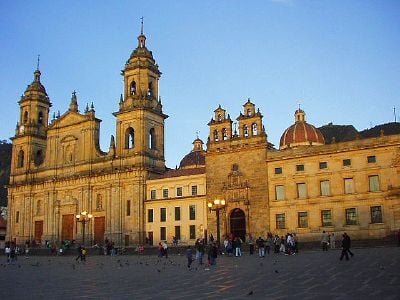
The government does not collect religious statistics, and authentic reports are hard to obtain. Based on diverse studies, more 95 percent of the population adheres to Christianity, most of them (81 to 90 percent) Roman Catholicism. Most i per centum practice indigenous religions. Under one percent practice Judaism, Islam, Hinduism, and Buddhism. Despite potent numbers of adherents, around 60 percent of respondents to a poll by El Tiempo report that they do not practise their faith actively.
The Colombian constitution guarantees religious freedom, but also states that the state "is not atheist or agnostic, nor indifferent to Colombians' religious sentiment." Religious groups are readily able to obtain recognition as organized associations, merely some smaller ones face difficulty in obtaining recognition as religious entities, which is required to offer chaplaincy services in public facilities.
Crime
Colombia has go notorious for its illicit drug product, kidnappings, and murder charge per unit. In the 1990s, information technology became the globe'southward largest producer of cocaine and coca derivatives. Cultivation of coca in 2000 was estimated at 402,782 acres (1,630 km²).
Drug cartels began utilizing terror to increase their bargaining power with the government. This resulted in homicide becoming the leading cause of decease in the nation. For a number of years, it had the highest murder rate in the world at 62 murders per 100,000 people. Withal, it has declined in recent years to 39 murders per 100,000 people, beneath the level of South Africa. Over 90 percent of the murdered are males.
Coca cultivation is a major illegal business organization in Republic of colombia. In several rural regions, big tracts of land have been used for coca plant cultivation. Co-ordinate to U.South. figures, in 2004 an estimated 281,947 acres (i,141 km²) of land were used to abound the plant, and the nation had a producing potential of 430,000 metric tons of cocaine per yr.
In 2006, the Colombian government destroyed effectually 180,387 acres (730 km²), beating all previous records in coca plant destruction. While Colombian efforts to eradicate the coca establish take displaced production, they have not diminished the area on which the crop is harvested.
Human rights situation
The 42-year internal armed conflict continued betwixt the regime and terrorist organizations, specially the Revolutionary Armed forces of Colombia (FARC) and the National Liberation Army (ELN). The United Cocky Defense Forces of Colombia (AUC) was demobilized by August 2006, but renegade AUC members who did not demobilize, or who demobilized but later abandoned the peace process, remained the object of military action. While civilian authorities generally maintained effective command of the security forces, there were instances in which elements of the security forces acted in violation of state policy.
The following societal problems and governmental human rights abuses were reported during 2006: Unlawful and extrajudicial killings; forced disappearances; insubordinate military collaboration with criminal groups; torture and mistreatment of detainees; overcrowded and insecure prisons; arbitrary arrest; loftier number of pretrial detainees, some of whom were held with convicted prisoners; dispensation; an inefficient judiciary subject to intimidation; harassment and intimidation of journalists; unhygienic conditions at settlements for displaced persons, with limited access to health care, education, or employment; corruption; harassment of human rights groups; violence against women, including rape; child abuse and child prostitution; trafficking in women and children for the purpose of sexual exploitation; societal bigotry against women, indigenous persons, and minorities; and illegal child labor.
Illegal armed groups committed the majority of homo rights violations. Despite a unilateral cease-fire alleged by the AUC in 2002 and a nationwide demobilization, renegade paramilitary members committed the post-obit criminal acts and human rights abuses: political killings and kidnappings; forced disappearances; torture; interference with personal privacy and with the political system; forced deportation; suborning and intimidation of judges, prosecutors, and witnesses; infringement on citizens' privacy rights; restrictions on freedom of movement; recruitment and employment of child soldiers; and harassment, intimidation, and killings of human rights workers, journalists, teachers, and trade unionists.
The FARC and ELN committed the following human rights violations: political killings; killings of off-duty members of the public security forces and local officials; kidnappings and forced disappearances; massive forced displacements; suborning and intimidation of judges, prosecutors, and witnesses; infringement on citizens' privacy rights; restrictions on liberty of movement; widespread recruitment of kid soldiers; attacks against human being rights activists; harassment, intimidation, and killings of teachers and trade unionists.
Representatives of the government, the ELN, civil society, and international observers continued meeting to explore a possible peace procedure and demobilization of the ELN. Regime steps to improve the human rights and security situation showed demonstrable results.
Culture
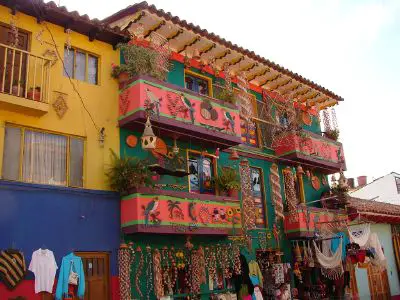
Arts and crafts in the town of Ráquira, Boyacá Department.
Due in part to geography, Colombian culture has been heavily fragmented into five major cultural regions. Rural to urban migration and globalization have changed how many Colombians alive and express themselves as large cities become melting pots of people (many of whom are refugees from various provinces fleeing fighting that has hit Colombia throughout its violent history). Well-nigh recent is the displacement to cities and other countries caused by the Colombian armed disharmonize.
Teaching
Over 93 percent of the unabridged population over 15 years of historic period tin can read and write, and this number continues to increment. Simply while literacy is at 93 per centum in urban areas, just 67 percent in rural areas are literate. The linguistic communication of teaching is Castilian.
Threescore percent of students complete master schooling (five years) and motility on to secondary schooling (six years). Primary education is complimentary and compulsory for 9 years for children betwixt 6 and 12 years of age. In many rural areas, teachers are poorly qualified and only five years of principal school are offered.
Republic of colombia has 24 public universities.
Transportation
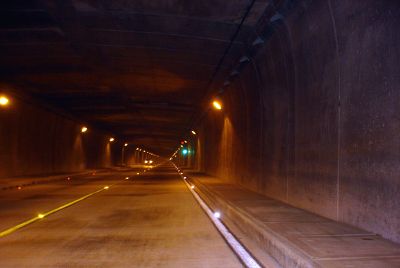
Occidente tunnel, Antioquia.
Republic of colombia has a network of national highways. The Pan-American Highway travels through Colombia, connecting the state with Venezuela to the e and Republic of ecuador to the due south. Colombia's principal airport is El Dorado International Airport in Bogotá. Several national and international airlines operate from El Dorado. Bogotá's drome is one of the largest and well-nigh expensive in Latin America. Because of its key location in Colombia and the Americas, information technology is preferred past national state transportation providers, also as national and international air transportation providers.
Notes
- ↑ Constitution of Colombia, 1991 (Article 10) Retrieved August 10,2022. (Spanish)
- ↑ two.0 2.ane Central Intelligence Agency, Colombia The World Factbook. Retrieved Baronial x, 2022.
- ↑ three.0 three.1 3.2 3.3 World Economical Outlook Database: Colombia International monetary fund, April 2022. Retrieved August ten, 2022.
- ↑ GINI index – Colombia World Bank. Retrieved August x, 2022.
- ↑ La Hora Legal Para Republic of colombia Instituto Nacional de Metrología. Retrieved Baronial 10, 2022.
- ↑ T. Van der Hammen, and G. Correal, Prehistoric Man on the Sabana de Bogota: Data for an Ecological Prehistory, Paleography, Paleoclimatology, Paleoecology 25 (1978): 179-190.
- ↑ Sylvia Broadbent, Los Chibchas: organización socio-política Série Latinoamericana 5 (Bogotá: Facultad de Sociología, Universidad Nacional de Colombia, 1964).
- ↑ Luis Gilberto Murillo Urrutia, El Choco: The African Heart of Colombia, The Journal of Pan African Studies 8(ii) (July 2015):256-260. Retrieved Baronial x, 2022.
References
ISBN links support NWE through referral fees
- Academia Colombiana de Historia. Historia extensa de Colombia (41 volúmenes). Bogotá: Ediciones Lerner, 1965-1986. ISBN 9589501338 (Obra completa)
- Buckman, Robert T. Latin America. Globe Today Serial. Harpers Ferry, WV: Stryker-Postal service Publications, 2006. ISBN 1887985751
- Bushnell, David. The Making of Modernistic Colombia: A Nation in Spite of Itself. Academy of California Press, 1993. ISBN 978-0520082892
- Cadavid Misas, Roberto. Cursillo de historia de Colombia: de la conquista a la independencia. Bogotá: Intermedio Editores, 2004. ISBN 9587091345
- Calderón Schrader, Camilo; Gil, Antonio; Torras, Daniel. Enciclopedia de Republic of colombia (4 volúmenes). Barcelona: céano Grupo Editorial, 2001. ISBN 8449419476 (Obra completa)
- Calderón Schrader, Camilo. Gran enciclopedia de Colombia (11 volúmenes). Bogotá: Círculo de Lectores, 1993. ISBN 9582802944 (obra completa)
- Cavelier Gaviria, Germán. Centenario de Panamá: una historia de la separación de Republic of colombia en 1903. Bogotá: Universidad Externado de Colombia, 2003. ISBN 9586167186
- Chasteen, John Charles. Born in Blood and Fire: A Concise History of Latin America. New York: W.W. Norton & Co., 2001. ISBN 0393050483
- Gómez Hoyos, Rafael. La independencia de Colombia. Madrid: Editorial Mapfre, Colecciones Mapfre, 1992. ISBN 8471005964
- Hernández de Alba, Guillermo. Como nació la República de Colombia. Colección Bolsilibros. Bogotá: Academia Colombiana de Historia, 2004. ISBN 9588040353
- Jaramillo Uribe, Jaime; Tirado Mejía, Álvaro; Calderón Schrader, Camilo. Nueva historia de Colombia (12 volúmenes). Bogotá: Planeta Colombiana Editorial, 2000. ISBN 9586142515 (Obra completa)
- Markham, Lois. Colombia: The Gateway to South America. New York: Marshall Cavendish, 1997. ISBN 0761401407
- Morrison, Marion. Colombia. New York: Grolier Publishing, 1999. ISBN 0516211064
- Reichel-Dolmatoff, Gerardo. Colombia indígena. Medellín: Hola Hill, 1998. ISBN 9586382761
- Streissguth, Tom. Republic of colombia in Pictures. Minneapolis, MN: Lerner Publications, 2004. ISBN 0822509334
External links
All links retrieved Baronial ten, 2022.
- (Spanish) Presidencia de la República de Colombia - President
- (Spanish) UNICEF en Republic of colombia
- (Spanish) Senate of Colombia
- Colombia CIA Earth Factbook
- (Spanish) El Colombiano Website for U.S. Weekly Paper Serving Colombian-American and Hispanic communities in South Florida
- Q&A: Colombia's ceremonious conflict BBC News
Credits
New Earth Encyclopedia writers and editors rewrote and completed the Wikipedia article in accordance with New Earth Encyclopedia standards. This article abides by terms of the Creative Commons CC-by-sa 3.0 License (CC-past-sa), which may be used and disseminated with proper attribution. Credit is due under the terms of this license that can reference both the New World Encyclopedia contributors and the selfless volunteer contributors of the Wikimedia Foundation. To cite this article click hither for a listing of adequate citing formats.The history of earlier contributions by wikipedians is attainable to researchers here:
- Republic of colombia history
The history of this article since it was imported to New World Encyclopedia:
- History of "Colombia"
Notation: Some restrictions may apply to use of individual images which are separately licensed.

What Is Colombia Named After,
Source: https://www.newworldencyclopedia.org/entry/Colombia
Posted by: normanpriese.blogspot.com
0 Response to "What Is Colombia Named After"
Post a Comment